Rewilding
Rewilding Therapy
Counselling and Psychotherapy · Archway, North London & Online

STILL ROOM
In old houses, the still room took its name from the still: an instrument, not a mood. Things went in whole — leaf and stalk and root — and came out essence, under a slow flame.
Remedies were kept here. So were poisons. The Greeks had one word for both: pharmakon.
Nothing hurried was done here.
An image arrives — a visitor, perhaps a stranger. Some history. The rest is looking.
Painting, sculpture, sound, dream — all image.

Klimt made separate studies of reclining bodies and closed-eyed faces for this painting. Here they are gathered into one floating mass of pattern and colour — several women tangled together, or one woman dreaming the rest of them. The ones she is. The ones she isn't. The ones she hasn't met.
All of them present. None of them chosen.
Who is dreaming whom?
Gustav Klimt, The Maiden, 1913, oil on canvas.
A woman stands before a closed door, a white platter balanced at her hip. She may only appear to have stopped. Almost nothing is happening. Or nothing we can see.
Her back is to us.
Vilhelm Hammershøi, Stue (Interior with an Oval Mirror), 1900, oil on canvas.


The hobbyhorse has been set down. At a low desk, a boy holds a brush. His older sister guides his hand. He is beginning the iroha, an old poem containing every sound in the Japanese syllabary once, and only once. It is a poem about things passing.
On the paper, the first sounds are written, repeated, begun again.
Who is guiding her?
Ikeda Shōen, Calligraphy Practice (Tenarai), 1909, two-panel screen; ink, colour and gold on silk.
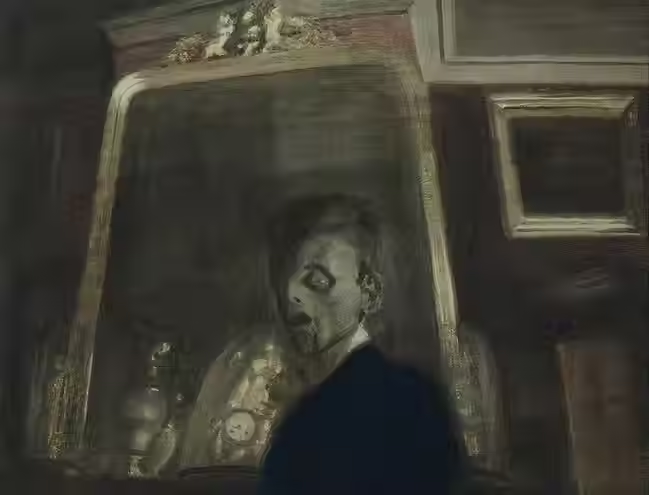
He painted himself repeatedly, at night, in a lamplit room in Ostend. From one self-portrait to the next, it is hard to tell whether each painting deepens the darkness or loosens it. His face lit, his mouth wide, the room gathering around him.
What has the mirror seen?
Léon Spilliaert — Self-Portrait with Mirror, 1908, Indian ink, watercolour and pastel on paper.

Soutine painted cooks, waiters, bellboys and servants, often in the uniforms that named them. Here the name barely holds. We do not know whether the sitter was a butcher; the title may come from the red curtain behind him, remembered as one Soutine found in a butcher’s shop in Céret. Face, collar and curtain have been dragged through the same reds.
Where is he without the red?
Chaïm Soutine, Butcher Boy, c. 1919–20, oil on canvas.
A sun opens in the dark. Inside it, an old man crouches with a pair of compasses. The world below has not yet taken shape, but already he has lowered them.
Blake called him Urizen: law, reason and limit made visible. Blake returned to the image for more than thirty years and, in his last days, was said to have coloured a final impression while propped up in bed.
He does not enter the dark. He measures it.
What is down there?
William Blake, Europe Plate i: Frontispiece (‘The Ancient of Days’), 1794, relief etching with hand-colouring.


Not painted, not drawn. She laid the seaweed on paper coated with iron salts and left it in the sun. The plant blocked the light; everything around it turned blue. She arranged the meeting; the sun did the rest.
What you are looking at is an absence — the shape of something that was here.
What is the white doing?
Anna Atkins, Dictyota dichotoma, in the young state; and in fruit, 1843–53, cyanotype.
What does the white hold?
What happens to it in the dark?
Three girls sit close enough for their colours to meet. Green, orange and red gather them into one shape. Their bodies overlap. Their gazes do not. None of them looks at us.
Someone called them girls.
Who named you?
Amrita Sher-Gil, Group of Three Girls, 1935, oil on canvas.


Painting had long been given the body of a woman. Artemisia gave that body her own. Sleeves pushed up, apron tied over her dress, she leans into the work. The canvas she is painting lies beyond the edge of ours.
She left Rome, established herself as an independent painter in Florence and, in 1616, became the first woman admitted to the Accademia del Disegno. By the time she painted this in London, she had been invited to the court of Charles I.
At seventeen, she had been raped by the painter Agostino Tassi and tortured while giving evidence at his trial. He was convicted; his punishment was never enforced.
What is she about to paint?
Artemisia Gentileschi, Self-Portrait as the Allegory of Painting (LaPittura), c. 1638–39, oil on canvas.
Cleopatra is already dead. Her head has fallen back; one arm hangs loose, the other rests across her lap, the asp still in her hand. Other sculptors showed her contemplating the act, idealised and composed. Lewis carved what came after.
Edmonia Lewis was the first sculptor of African American and Native American descent to achieve international recognition. In Rome, she did her own stonework, fearing that otherwise her work would not be accepted as original.
The sculpture was acclaimed at the 1876 Centennial Exhibition, then disappeared for almost a century. It passed through a Chicago saloon, marked the grave of a horse named Cleopatra, and eventually resurfaced in a salvage yard.
Edmonia Lewis, The Death of Cleopatra, carved 1876, marble.


A grid of steel crosses the clear glass, then draws inward around a tilted oval. The cross is still there. Not one of its lines reaches the centre unchanged.
The glass grows denser towards the oval. Light gathers where the structure gives way. The world outside remains visible through it. Nothing is broken.
Who taught the lines to be straight?
Shirazeh Houshiary and Pip Horne, East Window, St Martin-in-the-Fields, 2008, etched mouth-blown glass and stainless steel.
He composed music as well as painting, and gave his pictures the names of movements — allegro, andante, finale. This is the slow one. Andante: at walking pace. The painting is not.
Among the stars, something like a bridge — or a chain of light — is being held aloft.
How heavy is the light?
Mikalojus Konstantinas Čiurlionis, Sonata No. 6 (Sonata of the Stars). Andante, 1908, tempera on paper.

